


Marketing without a strategy is a lot like setting out on a road trip without a map. You might eventually get where you’re going, but not without wasted time, wrong turns, and unnecessary costs along the way.
Hydrate Marketing’s Growth Strategy Roadmap was built to solve that problem.
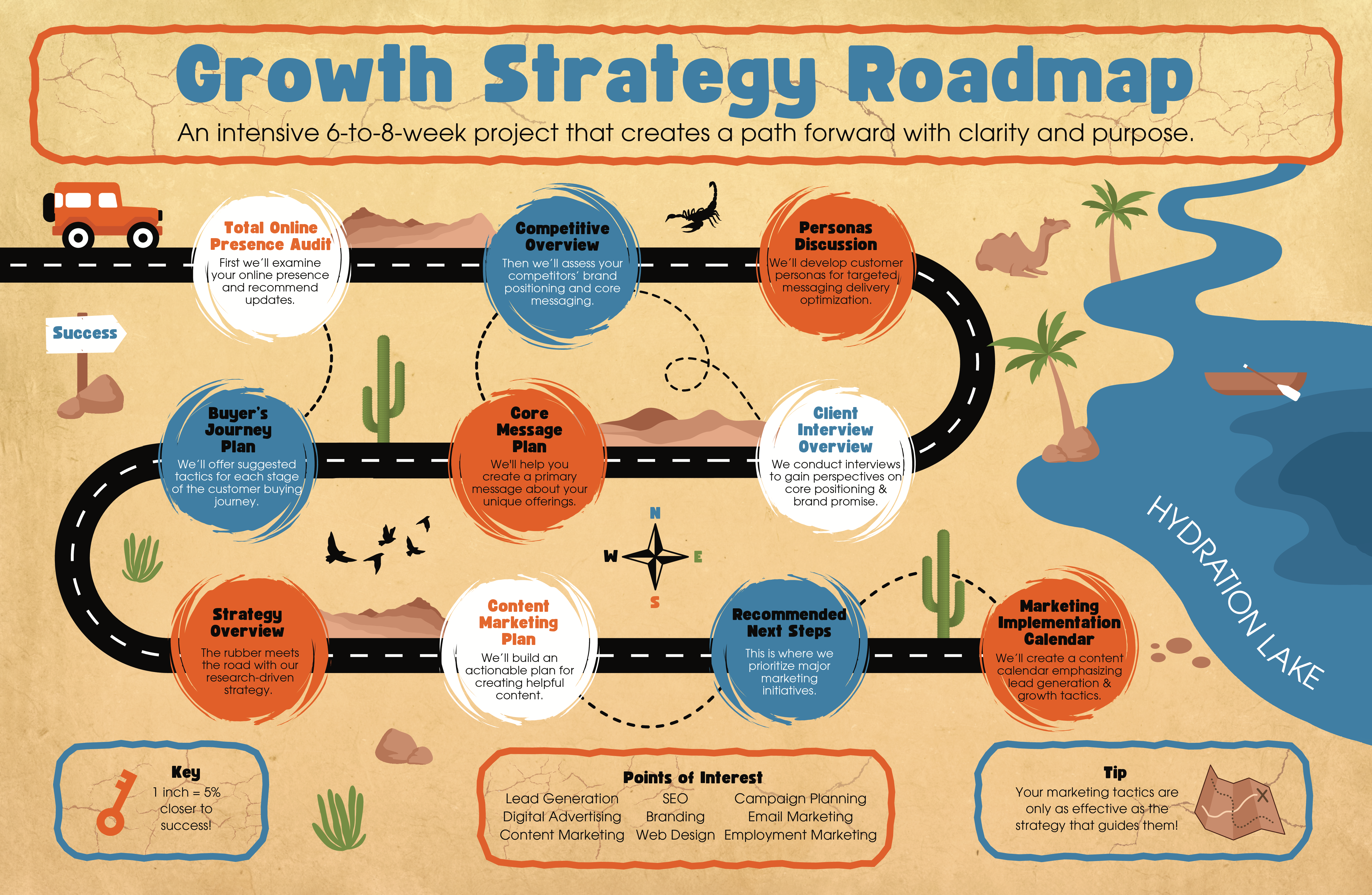
It’s an intensive six-to-eight-week process designed to create a clear path forward that’s grounded in data, aligned with your goals, and built for real-world execution. Instead of jumping straight into marketing tactics, it helps you understand where you are, where you want to go, and exactly how to get there.
We charted this map after realizing that a lot of our clients were experiencing similar pain points. No matter how many tactics we implemented for them, if they didn’t take our advice on aligning all these efforts with strategies to achieve their identified goals, it would be hard to do anything but spin our tires over time. So, we developed this step-by-step solution to the problem. The best part is, although it’s a repeatable process, we always customize it for each client's needs.
Every journey to business growth will look different, but no matter the type of business or organization, your marketing tactics are only as effective as the strategy that guides them.
Key Points
- A clear marketing strategy eliminates guesswork and wasted effort.
- Understanding your audience leads to more effective messaging.
- Differentiation comes from clarity, not complexity.
- Content should guide customers through their journey.
- Consistent execution is what turns strategy into results.
Table of Contents
- Why a Roadmap Matters
- Starting Point: Total Online Presence Audit
- Understanding the Landscape: Competitive Overview
- Defining Your Audience: Personas Discussion
- Aligning Internally: Client Interview Overview
- Sharpening Your Voice: Core Message Plan
- Charting the Course: Buyer’s Journey Plan
- Bringing It Together: Strategy Overview
- Fueling Growth: Content Marketing Plan
- Prioritizing Action: Recommended Next Steps
- Staying on Track: Marketing Implementation Calendar
- From Strategy to Execution
Why a Roadmap Matters
Imagine taking a trip before maps and GPS—you’d rely on guesswork, scattered directions, and a lot of trial and error. That’s what marketing looks like without a strategy.
Many businesses invest in campaigns, content, and ads, but without a clear plan, those efforts often feel disconnected. The Growth Strategy Roadmap changes that. It connects every decision back to a defined goal and ensures each step builds on the last.
Starting Point: Total Online Presence Audit
Before you hit the road, you must understand where you are starting from. This is why our mapping process begins with a complete evaluation of your online presence, including your website, search visibility, content performance, and digital channels. The goal isn’t just to identify what exists—it’s to uncover what’s working, what isn’t, and where opportunities are being missed. From there, clear recommendations are made to strengthen your foundation before moving forward.
Understanding the Landscape: Competitive Overview
Once you know your starting point, the next step is understanding the terrain around you. A competitive overview closely examines how others in your space position themselves.
Depending on your industry, you may not really have competitors, but rather, partners. We see this a lot with our nonprofit clients. This overview is still a good exercise, even in that scenario, because it’s not about figuring out how to “beat” your competitors. It simply evaluates their messaging, branding, and marketing strategies.
We don’t suggest you exactly replicate what is revealed. Sure, it may inspire you to try similar tactics, or flag some that you want to avoid. However, the real benefit of the competitive overview is that it identifies industry standards and opportunities you have to exceed them.
Defining Your Audience: Personas Discussion
Marketing becomes significantly more effective when it speaks to specific demographic and psychographic audiences instead of a broad one. Through persona development, you gain a deeper understanding of who your ideal customers are, what they care about, and how they make decisions. This includes their goals, challenges, and the factors that influence trust. The result is messaging that feels intentional and targeted, rather than generic and easy to ignore.
Aligning Internally: Client Interview Overview
Before refining your external messaging, it’s critical to assess how current clients and team members talk about you. Client interviews provide the most accurate Voice of Customer (VOC), helping you understand the value you provide to your target personas, in their own words. We also often conduct internal interviews at this stage, which provides insight into how leadership and employees view the business and its existing positioning.
These conversations often uncover gaps between perception and reality, both internally and externally. This step ensures that your strategy is not only market-informed but also aligned with your organization’s vision and direction. A bonus is that you can use the interviews in marketing tactics once your strategy is set. For example, we were able to incorporate many quotes and testimonials from our initial interviews into the TSS Advisors website once we started optimizing it. People are much more likely to be convinced to do business when you have evidence, like positive reviews, to back up what you’re saying about your company!
Sharpening Your Voice: Core Message Plan
With a clear understanding of your audience and positioning, the next step is defining how you communicate. This stage focuses on creating primary messaging that clearly articulates your unique offerings. It answers essential questions: what you do, who you help, and why it matters. A strong core message removes confusion. It makes your value easy to understand, and therefore, easier to trust. Above all, it should make your target personas feel seen and encourage them to act.
Charting the Course: Buyer’s Journey Plan
However, not every potential customer will be ready to act immediately. That’s why your marketing needs to meet them where they are. The buyer’s journey plan maps out how your marketing tactics support each stage of the decision-making process—from awareness to consideration to that final decision. This ensures your marketing doesn’t just attract attention, but guides prospects forward in a meaningful way.
Bringing It Together: Strategy Overview
This is where everything connects. The strategy overview translates research and insights into a clear, actionable plan. It defines your goals, key performance indicators (KPIs), and the channels that will drive results. It’s the point where ideas become direction and where your roadmap truly takes shape.
Don’t underestimate the importance of taking in the full overview. You can consider it to be your north star. If you switch back to chasing vanity metrics instead of the agreed-upon KPIs, you’ll end up lost in the woods again. To help our clients stay the course, we produce regular analytics reports using DashThis with their goals right at the top to serve as a gentle reminder and provide context on which of the following numbers are important for them to track and why.
Fueling Growth: Content Marketing Plan
Content is how you share your strategy-driven external messaging and get the word out about your business. A strong content marketing plan outlines what you’ll create, who it’s for, and how it supports your broader goals. The focus is on producing helpful, relevant assets that build trust and answer the questions your leads are really asking. This isn’t about more output and increased frequency. It’s about purposeful messaging and consistent touchpoints that move the needle.
Prioritizing Action: Recommended Next Steps
Even the best strategy needs prioritization. This step identifies the most impactful initiatives to focus on first. It removes overwhelm and creates clarity around what should happen next.
We often use the Eisenhower Matrix when deciding which tactic to tackle at any given time. If a task is date-bound with the deadline approaching and aligned with your overall strategy, it’s both urgent and important, so it should be completed right away. In opposition, if there’s something else you’ve had on the to-do list for a while, we first consider if it truly fits into your strategy-informed marketing initiative. If you’ve been pushing it off, there’s a large chance you’ve subconsciously known for a while that it’s not that important, which means we can table it or scrap it altogether.
No one can do everything all at once. Prioritization is key because it enables you to move forward with purpose.
Staying on Track: Marketing Implementation Calendar
Marketing strategy requires structure. The implementation calendar maps out your campaigns, content, and initiatives over time. We break all that down and spell it out in a spreadsheet. Don’t be scared! That may sound like you have an Excel-induced headache in your future, but we promise we’ll keep it simple and walk you through it.
The result emphasizes consistency and ensures your strategy is carried out in a way that supports lead generation and growth. With a clear, prioritized timeline in place, your team can move forward with confidence.
From Strategy to Execution
Once your roadmap is complete, the focus shifts from planning to action. This is where strategy comes to life through blog content, digital advertising, email marketing, website optimization, and so much more. Each tactic is guided by the strategy we’ve built, ensuring that every effort contributes to measurable results. Without that foundation, marketing tactics can feel disconnected. With it, they become powerful drivers of business growth.
If you’re ready to bring more clarity and direction to your marketing, we encourage you to explore our website to learn more about the Growth Strategy Roadmap engagement.